
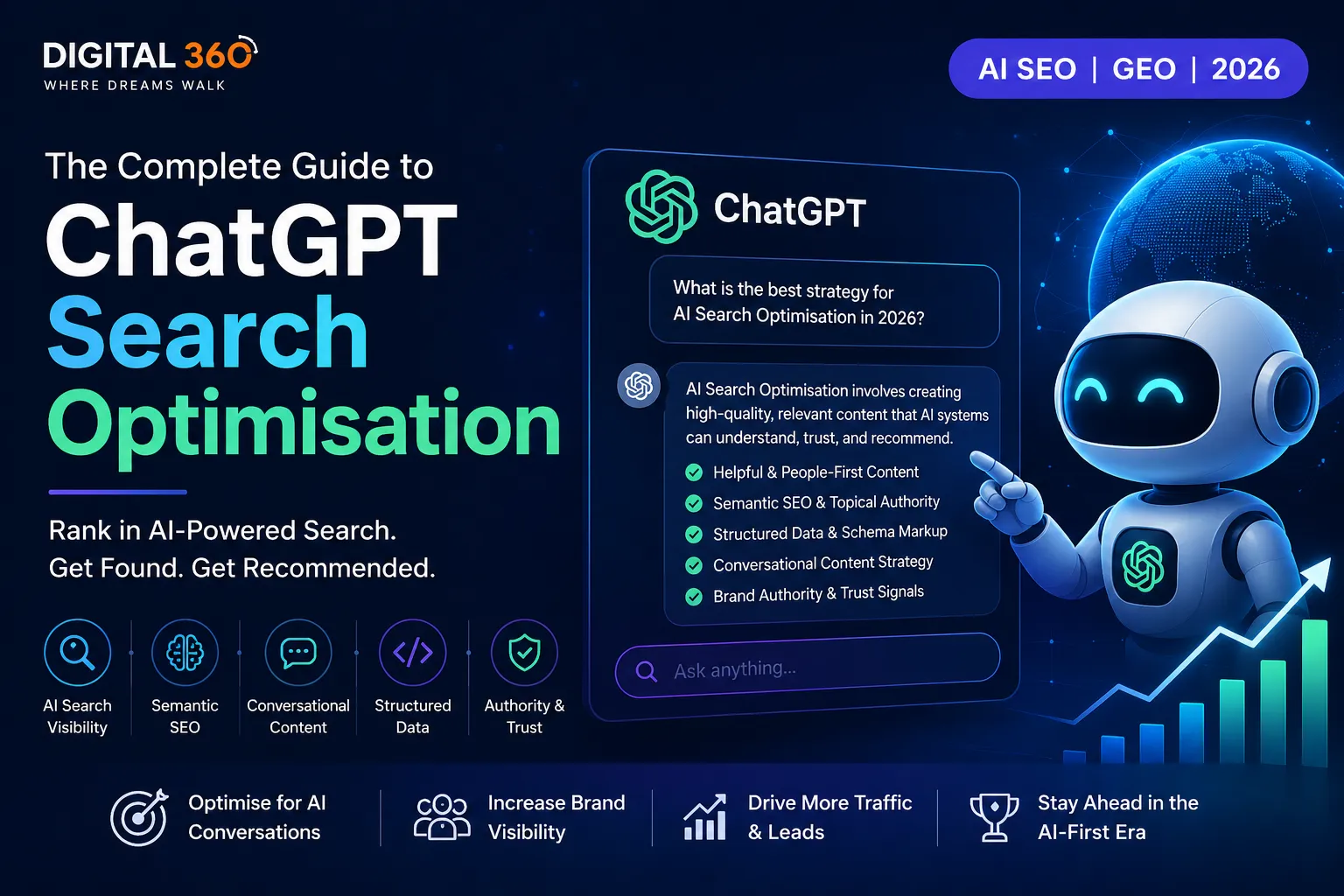
1. Introduction – The Search Industry Has Changed in 2026
The digital search industry has changed dramatically in 2026. For years, businesses focused mainly on traditional SEO strategies to rank on Google search results. Companies optimized websites using keywords, backlinks, metadata, and technical SEO to appear on the first page of search engines. While SEO still matters today, the way people search online has evolved rapidly because of artificial intelligence.
Users are no longer typing short search queries like:
- “best digital marketing company”
- “SEO company near me”
- “how to rank website”
Instead, they are asking conversational questions directly to AI-powered search engines and AI assistants such as:
- “Which digital marketing company is best for AI SEO?”
- “How can my business appear in ChatGPT answers?”
- “What is the best strategy for AI search optimization in 2026?”
This shift has completely transformed the search ecosystem.
Platforms like:
- ChatGPT
- Google Gemini
- Perplexity AI
- Microsoft Copilot
- AI Overviews in Google Search
are changing how users discover information online. Instead of showing only a list of websites, AI platforms now generate direct answers, summaries, recommendations, and conversational responses.
This means businesses are facing a new challenge.
Even if your website ranks on Google, your brand may still remain invisible inside AI-generated answers if your content is not optimized for AI search systems.
That is where ChatGPT Search Optimisation becomes essential.
In 2026, businesses are realizing that ranking on Google alone is no longer enough. Brands now need visibility inside AI-generated conversations and AI-powered search experiences.
This evolution has introduced a new digital marketing concept called:
Generative Engine Optimization (GEO)
GEO focuses on helping brands appear in AI-generated responses by optimizing content for:
- Conversational search
- Semantic relevance
- AI readability
- Contextual understanding
- Trustworthiness
- Structured information
AI search engines do not think like traditional search engines.
They analyze:
- Meaning
- Context
- Intent
- Authority
- User satisfaction
- Content usefulness
instead of only exact-match keywords.
This is why businesses using outdated SEO techniques are losing visibility in 2026.
Many websites still focus heavily on:
- Keyword stuffing
- Thin content
- Generic AI articles
- Low-quality backlinks
- Repetitive optimization tricks
But AI systems prioritize:
- Helpful answers
- Expert insights
- Well-structured content
- Trust signals
- Conversational readability
The future of search belongs to businesses that adapt early.
Companies that understand AI Search Optimization today will dominate visibility tomorrow.
This is why brands across industries are now investing in:
- ChatGPT Search Optimisation
- AI SEO strategies
- Conversational content marketing
- GEO frameworks
- AI-friendly website architecture
Digital marketing agencies are also evolving rapidly to help businesses stay visible in this new AI-first internet ecosystem.
The brands that adapt now will become trusted AI-recommended businesses in the future.
As AI search continues to grow between 2026 and 2030, businesses that ignore AI optimization may lose traffic, leads, and online authority.
The future of digital visibility is no longer just about search rankings.
It is about becoming a trusted source for AI-generated answers.
2. What is ChatGPT Search Optimisation?
ChatGPT Search Optimisation is the process of optimizing digital content, websites, and online brand presence so that AI-powered search engines and conversational AI platforms can easily understand, trust, and recommend them in generated answers.
In simple words, it is the modern evolution of SEO designed specifically for artificial intelligence search systems.
Traditional SEO focused mainly on helping websites rank higher on search engine result pages (SERPs). Businesses optimized pages for keywords, backlinks, title tags, and metadata to improve visibility on Google.
However, AI-powered search systems work differently.
Platforms like ChatGPT, Gemini, and Perplexity AI do not simply display a list of links. Instead, they analyze information from multiple sources and generate direct conversational responses for users.
This changes the entire optimization strategy.
Traditional SEO vs ChatGPT Search Optimisation
| Traditional SEO | ChatGPT Search Optimisation |
|---|---|
| Focus on rankings | Focus on AI visibility |
| Keyword optimization | Context optimization |
| Search engine crawling | AI understanding |
| SERP clicks | AI mentions |
| Backlinks | Authority + trust |
| Metadata importance | Conversational quality |
In AI search systems, content must be understandable not only for humans but also for artificial intelligence models.
That means businesses need content that includes:
- Clear explanations
- Structured formatting
- Entity-based optimization
- Context-rich answers
- Conversational language
- Expert-driven insights
Understanding Conversational Search
One of the biggest changes in 2026 is the rise of conversational search.
Users now interact with AI the same way they talk to humans.
Instead of searching:
“best SEO company Noida”
Users ask:
“Which company provides the best AI SEO services for businesses in Noida?”
AI systems interpret the meaning behind the question instead of matching exact keywords only.
This means content must answer real user intent naturally.
What AI Models Look For
AI systems evaluate several factors before using content in generated answers.
These include:
1. Relevance
The content must directly answer the user’s question.
2. Context
AI understands relationships between topics, entities, and concepts.
3. Trust Signals
Author expertise, brand reputation, citations, reviews, and authority matter heavily.
4. Structured Information
Headings, bullet points, FAQs, and organized content help AI extract information easily.
5. Human Readability
AI prefers content written naturally for users rather than over-optimized robotic writing.
What is GEO (Generative Engine Optimization)?
Generative Engine Optimization (GEO) is the advanced AI-era version of SEO.
GEO focuses specifically on optimizing content for AI-generated search experiences.
The goal is not only to rank on Google but also to become part of AI-generated recommendations and summaries.
GEO strategies include:
- Conversational content writing
- Semantic SEO
- AI-friendly formatting
- Entity optimization
- Topical authority building
- Structured data implementation
- E-E-A-T optimization
Why ChatGPT Search Optimisation Matters
Businesses that ignore AI optimization may face serious visibility challenges in coming years.
Users increasingly trust AI-generated recommendations because they provide:
- Faster answers
- Simplified information
- Personalized responses
- Multi-source summaries
If your business is not optimized for AI search, competitors may dominate AI-generated recommendations even if your website ranks well traditionally.
This is why ChatGPT Search Optimisation has become one of the most important digital marketing strategies in 2026.
Businesses now need to optimize for:
- Human readers
- Search engines
- AI systems
simultaneously.
The future of online visibility depends on becoming AI-readable, trustworthy, and contextually relevant.
3. How AI Search Works in 2026
AI search engines in 2026 operate very differently compared to traditional search engines from previous years.
Traditional search systems mainly focused on:
- Crawling web pages
- Indexing content
- Matching keywords
- Ranking websites
But AI-powered search platforms go far beyond simple keyword matching.
Modern AI systems understand:
- User intent
- Context
- Language patterns
- Relationships between topics
- Conversational meaning
- Semantic relevance
This creates a completely new search experience for users.
AI Search Engines vs Traditional Search Engines
Traditional search engines display a list of web pages related to a search query.
AI search engines generate complete answers directly inside the interface.
For example:
Traditional Search
A user searches:
“Best AI SEO strategy”
Google may show:
- Blog articles
- Agency websites
- Videos
- Forums
The user then clicks multiple links to find answers.
AI Search
A user asks ChatGPT:
“How can businesses optimize for AI search in 2026?”
The AI immediately generates:
- Detailed explanations
- Strategies
- Comparisons
- Actionable recommendations
without requiring multiple website visits.
This is why AI search is becoming increasingly popular.
Conversational Search Experience
Conversational search is one of the biggest transformations in digital marketing.
Users now interact with AI naturally.
Examples include:
- “Which SEO strategy works best for AI search?”
- “How can my local business rank in ChatGPT?”
- “What are the ranking factors for AI search engines?”
AI systems process these questions contextually rather than literally.
This allows users to:
- Ask follow-up questions
- Continue conversations
- Get personalized answers
- Receive summarized information
The experience feels closer to talking with an expert rather than using a search engine.
AI-Generated Summaries
AI search platforms summarize information from multiple trusted sources to create direct responses.
Instead of ranking a single webpage, AI systems analyze:
- Website authority
- Contextual accuracy
- Topical relevance
- Structured information
- Brand mentions
- Semantic relationships
Then they generate concise answers.
This means businesses must optimize content in ways that AI systems can easily extract and understand.
Semantic Understanding
Semantic SEO has become extremely important in 2026.
AI systems no longer rely only on exact keywords.
They understand related concepts and topic relationships.
For example, if a page discusses:
- AI SEO
- GEO
- Conversational search
- AI ranking factors
- Semantic optimization
AI systems understand that all these concepts are connected.
This improves the likelihood of content being referenced in AI-generated responses.
Natural Language Processing (NLP)
AI search engines use advanced Natural Language Processing (NLP) to understand human communication.
NLP helps AI systems analyze:
- Sentence structure
- User intent
- Emotional tone
- Contextual meaning
- Conversational flow
This is why robotic keyword-heavy content performs poorly in AI search.
Content must now sound:
- Natural
- Helpful
- Human
- Informative
- Contextually complete
Search Intent Analysis
AI systems focus heavily on understanding why users are searching.
Intent categories include:
Informational Intent
Users seeking knowledge.
Example:
“What is ChatGPT Search Optimisation?”
Commercial Intent
Users comparing services or products.
Example:
“Best AI SEO agency for businesses.”
Transactional Intent
Users ready to buy or contact.
Example:
“Hire AI search optimization company.”
Navigational Intent
Users searching for a specific brand or website.
AI platforms tailor responses according to intent.
This is why content strategy must include multiple content formats.
Multi-Source Answer Generation
Modern AI systems collect information from various sources, including:
- Websites
- Reviews
- Forums
- News
- Structured databases
- Social mentions
- Knowledge panels
This means brand authority across the internet matters more than ever.
A business with:
- Strong PR
- Expert articles
- Positive reviews
- Active social media
- High topical authority
has better chances of appearing in AI-generated answers.
Major AI Search Platforms in 2026
OpenAI ChatGPT
One of the most influential conversational AI systems.
Google Gemini
Integrated deeply into Google Search and AI Overviews.
Perplexity AI
Popular for research-based conversational search.
Microsoft Copilot
Integrated into Microsoft ecosystem and enterprise search.
These platforms are collectively reshaping digital visibility.
Businesses that optimize early for AI search ecosystems will gain a massive competitive advantage in coming years.
The future of search is conversational, intelligent, contextual, and AI-driven.
4. Why Traditional SEO Alone is Not Enough Anymore
For many years, businesses relied heavily on traditional SEO techniques to improve rankings on Google. Strategies such as keyword optimization, backlink building, metadata improvement, and technical SEO helped websites gain traffic from search engines.
While traditional SEO still plays an important role in 2026, it is no longer enough by itself.
The search ecosystem has evolved because AI-powered search platforms now influence how users discover information online.
Platforms like:
- ChatGPT
- Google Gemini
- Perplexity AI
- Microsoft Copilot
are changing user behavior rapidly.
Instead of clicking through multiple websites, users increasingly depend on AI-generated answers.
This means businesses must optimize not only for search engines but also for artificial intelligence systems.
Keyword Stuffing No Longer Works
In earlier SEO strategies, many websites attempted to rank by repeating keywords excessively throughout content.
For example:
- Repeating the same phrase unnaturally
- Creating low-value content around exact keywords
- Using robotic optimization tactics
These outdated methods are now ineffective for AI search systems.
AI models prioritize:
- Natural language
- Context
- Relevance
- User satisfaction
- Information quality
If content feels overly optimized or unnatural, AI systems may consider it less trustworthy.
Modern AI algorithms are advanced enough to recognize:
- Manipulative content
- Thin information
- Low-value AI-generated articles
- Spam-style optimization
As a result, businesses must now focus on genuinely helpful content.
AI Focuses on Helpfulness
One of the biggest differences between traditional SEO and ChatGPT Search Optimisation is that AI systems prioritize usefulness over technical manipulation.
AI search engines aim to provide users with:
- Direct answers
- Expert explanations
- Clear guidance
- Context-rich information
This means content must solve user problems effectively.
AI systems analyze whether content:
- Answers questions properly
- Provides depth
- Explains concepts clearly
- Uses trustworthy information
- Demonstrates expertise
Helpful content is more likely to appear in AI-generated recommendations.
Search Intent Matters More Than Ever
Traditional SEO often focused heavily on exact keywords.
But AI search systems understand intent behind user questions.
For example:
A user searching:
“Best AI SEO strategy for local businesses”
may actually want:
- Practical implementation tips
- Budget-friendly solutions
- Agency recommendations
- Technical guidance
AI systems analyze the broader meaning behind the search instead of focusing only on keywords.
This is why businesses need intent-focused content strategies.
Content Depth and Authority Are Essential
AI systems prefer detailed and authoritative content.
Short, shallow blog posts with limited value are becoming less effective.
Modern AI search engines favor:
- Comprehensive guides
- Expert insights
- Industry analysis
- Data-driven content
- Step-by-step explanations
- Case studies
Businesses must build topical authority around their industry.
This means creating interconnected content covering:
- Core topics
- Related concepts
- Supporting questions
- Industry trends
Topical authority helps AI systems recognize a brand as a reliable information source.
AI Prefers Context-Rich Answers
AI models understand relationships between ideas and topics.
This is why context-rich content performs better in AI search.
For example, a blog about ChatGPT Search Optimisation should naturally include related concepts such as:
- GEO
- AI SEO
- Semantic search
- Conversational optimization
- E-E-A-T
- Structured data
- NLP optimization
AI systems analyze these relationships to evaluate relevance and depth.
Trust and Expertise Matter More in 2026
Trust signals have become extremely important for AI visibility.
AI systems evaluate:
- Brand reputation
- Author credibility
- Online mentions
- Reviews
- Content consistency
- Expertise signals
Businesses without strong authority may struggle to appear in AI-generated answers.
This is why companies now invest in:
- PR campaigns
- Expert-led content
- Personal branding
- Thought leadership
- Industry authority building
Traditional SEO vs ChatGPT Search Optimisation
| Traditional SEO | ChatGPT Search Optimisation |
|---|---|
| Keywords | Context |
| Rankings | AI Mentions |
| Search Queries | Conversations |
| Backlinks | Authority + Trust |
| Metadata | Answer Quality |
| Clicks | Recommendations |
| SERP Position | AI Visibility |
The Future Requires SEO + GEO Together
Traditional SEO is not disappearing.
Instead, it is evolving.
Businesses now need a combined strategy that includes:
- SEO
- GEO
- Conversational optimization
- Semantic search optimization
- AI content structuring
- Authority building
The future belongs to brands that can optimize for both:
- Search engines
- AI-generated search experiences
Companies that adapt early will dominate digital visibility in the AI-first era.
5. What Are the Ranking Factors for ChatGPT Search Optimisation?
Understanding ranking factors is one of the most important aspects of ChatGPT Search Optimisation in 2026.
Unlike traditional SEO, AI-powered search systems use advanced contextual analysis to determine which content deserves visibility inside generated answers.
AI search platforms evaluate:
- Trust
- Relevance
- Structure
- Semantic depth
- User value
- Authority
- Content quality
Businesses that optimize for these factors have a higher chance of appearing in AI-generated responses.
Below are the major ranking factors influencing AI search visibility in 2026.
A. E-E-A-T (Experience, Expertise, Authority, Trustworthiness)
E-E-A-T remains one of the strongest ranking signals in AI search optimization.
AI systems want to provide users with trustworthy information.
That means content must demonstrate:
Experience
Real-world practical knowledge.
Examples include:
- Industry experience
- Hands-on expertise
- Case studies
- Real business insights
Expertise
Deep understanding of a subject.
Expert-level content performs better than generic AI-generated articles.
Authority
How recognized your brand or author is within the industry.
Authority signals include:
- Brand mentions
- PR articles
- Expert interviews
- Social proof
- Industry recognition
Trustworthiness
Trust is critical in AI-generated answers.
AI systems analyze:
- Website security
- Accurate information
- Author transparency
- Consistent branding
- Reliable sources
Brands with stronger E-E-A-T signals are more likely to be referenced by AI systems.
B. Conversational Content
AI search platforms are built around conversations.
This means conversational content performs significantly better than robotic SEO writing.
Human-Style Writing
Content should sound natural and easy to understand.
Avoid:
- Over-optimization
- Repetitive keywords
- Robotic sentence structures
Instead, focus on:
- Clarity
- Simplicity
- Helpful explanations
- Natural language
Question-and-Answer Format
AI systems prefer content that directly answers questions.
Examples include:
- What is ChatGPT Search Optimisation?
- How does AI search work?
- Why is GEO important in SEO?
This structure aligns perfectly with conversational AI systems.
Readability Matters
AI systems favor content that users can easily consume.
Important readability elements include:
- Short paragraphs
- Clear headings
- Bullet points
- Simple explanations
- Logical formatting
C. Structured Content
Structured formatting plays a major role in AI visibility.
AI systems need easily extractable information.
Well-structured content helps AI models understand page context quickly.
Important Structure Elements
Headings
Clear H1, H2, and H3 hierarchy improves AI comprehension.
FAQs
FAQ sections are highly effective because they mimic conversational search behavior.
Bullet Points
Bullet points simplify information extraction.
Tables
Comparison tables help AI summarize information efficiently.
Why Structure Matters
Structured content improves:
- AI readability
- Semantic understanding
- Information extraction
- User experience
This is why long-form structured guides perform well in AI search systems.
D. Semantic SEO
Semantic SEO focuses on meaning and topic relationships rather than exact keywords only.
AI systems understand connected concepts.
For example, content about ChatGPT Search Optimisation should naturally include related entities like:
- AI SEO
- GEO
- Conversational search
- Semantic search
- NLP optimization
- AI search engines
This creates deeper topical relevance.
Topic Clusters
Topic clustering is extremely important in 2026.
Instead of publishing isolated blogs, businesses should create interconnected content ecosystems.
Example cluster:
- ChatGPT Search Optimisation
- AI SEO Guide
- GEO Strategies
- AI Ranking Factors
- Structured Data for AI Search
- Conversational Content Writing
This builds authority around a niche.
E. Brand Mentions Across the Web
AI systems analyze overall brand presence online.
Strong brands are more likely to appear in AI-generated recommendations.
Important authority signals include:
PR Articles
Media mentions increase trustworthiness.
Reviews
Positive reviews improve credibility.
Social Media Mentions
Consistent online discussions strengthen brand visibility.
Citations
Business references across platforms improve authority.
AI systems recognize brands that are discussed widely across the internet.
F. Updated Content
Freshness matters significantly in AI search.
AI systems prefer updated information because technology, trends, and industries evolve rapidly.
Outdated content may lose visibility over time.
Businesses should regularly update:
- Statistics
- Industry trends
- Examples
- Case studies
- Technical information
Updated content signals relevance and trust.
Additional AI Ranking Factors in 2026
Other important factors include:
Mobile Optimization
AI systems favor mobile-friendly websites.
Website Speed
Fast-loading websites improve user experience.
HTTPS Security
Secure websites gain trust advantages.
User Engagement
Helpful content with strong engagement signals performs better.
Entity Optimization
Clear brand identity improves AI recognition.
The Core Goal of AI Search Ranking
Ultimately, AI systems want to recommend the best possible answers for users.
That means businesses must focus on:
- Helping users
- Building authority
- Providing accurate information
- Structuring content properly
- Demonstrating expertise
The future of digital marketing belongs to brands that become trusted AI information sources.
6. What Type of Content Performs Best in AI Search?
Not all content performs equally in AI-powered search systems.
In 2026, AI platforms prioritize content that is:
- Helpful
- Structured
- Detailed
- Conversational
- Context-rich
- Easy to extract information from
Businesses creating high-quality AI-friendly content have a much better chance of appearing in ChatGPT responses and AI-generated recommendations.
Below are the content formats that perform best in AI search environments.
1. Long-Form Guides
Comprehensive long-form content performs exceptionally well in AI search optimization.
AI systems prefer detailed guides because they provide:
- Topic depth
- Semantic relevance
- Multiple related concepts
- Better contextual understanding
For example:
A 5000-word guide about ChatGPT Search Optimisation is more useful for AI systems compared to a 500-word shallow article.
Long-form content helps establish:
- Authority
- Expertise
- Trustworthiness
- Topical relevance
This is why comprehensive educational content dominates AI visibility.
2. FAQ-Based Content
FAQs are extremely powerful for AI search.
AI systems are conversational by nature.
FAQ sections align perfectly with how users ask questions.
Examples include:
- What is AI SEO?
- How does ChatGPT Search Optimisation work?
- Why is GEO important in 2026?
FAQ sections help AI systems extract direct answers quickly.
Benefits include:
- Better conversational relevance
- Improved snippet extraction
- Higher AI readability
- Enhanced semantic clarity
3. Comparison Articles
AI users frequently search for comparisons.
Examples include:
- Traditional SEO vs AI SEO
- Google SEO vs ChatGPT Search Optimisation
- GEO vs SEO
- AI search engines vs traditional search
Comparison content performs well because it:
- Simplifies decision-making
- Provides contextual understanding
- Helps AI summarize differences clearly
Tables and side-by-side comparisons further improve AI extraction capabilities.
4. Step-by-Step Tutorials
Practical instructional content performs extremely well in AI search systems.
Users increasingly ask AI:
- “How can I optimize my website for AI search?”
- “How do I implement schema markup?”
- “How can businesses rank in ChatGPT?”
Step-by-step guides provide actionable value.
AI systems favor practical educational content because it directly solves user problems.