Microsoft Launches AI Max and New Ad Tools for the Agentic Web Era
1. Introduction: The Rise of the Agentic Web
The internet is no longer just searchable—it is becoming actionable. Over the past two decades, we have seen a dramatic transformation in how users interact with digital platforms. Initially, the web was a static space where users consumed information. Then came search engines, allowing users to actively find what they needed. This evolved further into AI-driven search, where answers are presented directly without requiring users to browse multiple links. Now, we are entering the era of the Agentic Web, where artificial intelligence does not just assist users but actively performs tasks on their behalf.
This shift is being led by major technology companies such as Microsoft, which has recently introduced AI Max along with a suite of new advertising tools designed specifically for this new internet paradigm. These innovations are not incremental improvements—they represent a complete overhaul of how digital marketing, advertising, and user engagement function.
For businesses, this transformation is critical. The traditional model of attracting users through clicks and website visits is gradually being replaced by AI-driven recommendations and automated decision-making. Marketers must now rethink their strategies, focusing on how to influence AI systems rather than just human users.
For SEO professionals, the challenge is even greater. The shift toward AI-generated answers and zero-click searches means that visibility within AI ecosystems is becoming more important than traditional rankings. This is where the role of companies like Digital 360 becomes crucial, as they help businesses adapt to this evolving landscape.
This marks a major shift in how users interact with ads and content.
2. What is the “Agentic Web”?
The Agentic Web is the next evolution of the internet, where AI-powered agents take an active role in performing tasks for users instead of simply providing information. In traditional web environments, users are responsible for searching, comparing, and making decisions. However, in the Agentic Web, AI systems handle these processes autonomously, significantly reducing the effort required from users.
At its core, the Agentic Web is built around intelligent AI assistants such as Microsoft Copilot, which can understand user intent, analyze data in real time, and execute actions like booking services, recommending products, or even completing transactions. This represents a fundamental shift from a search-based web, where users actively seek information, to an action-based web, where AI anticipates needs and delivers outcomes.
For example, instead of manually searching for the best flight deals, comparing prices across multiple platforms, and booking tickets, an AI agent can complete the entire process within seconds. Similarly, when shopping online, AI can analyze preferences, compare options, and recommend the best product without requiring the user to visit multiple websites.
One of the most significant implications of the Agentic Web is the reduction of traditional browsing behavior. Users are less likely to click on ads or visit multiple websites because AI systems provide direct answers and recommendations. This leads to a new form of interaction where trust in AI becomes more important than brand visibility through traditional channels.
For businesses and marketers, this means adapting to a new reality where influence over AI decision-making becomes more valuable than traditional advertising techniques. The focus shifts from attracting clicks to becoming a trusted source that AI systems rely on for recommendations.
The key takeaway is simple: users will rely more on AI decisions than manual exploration.
3. What is Microsoft AI Max?
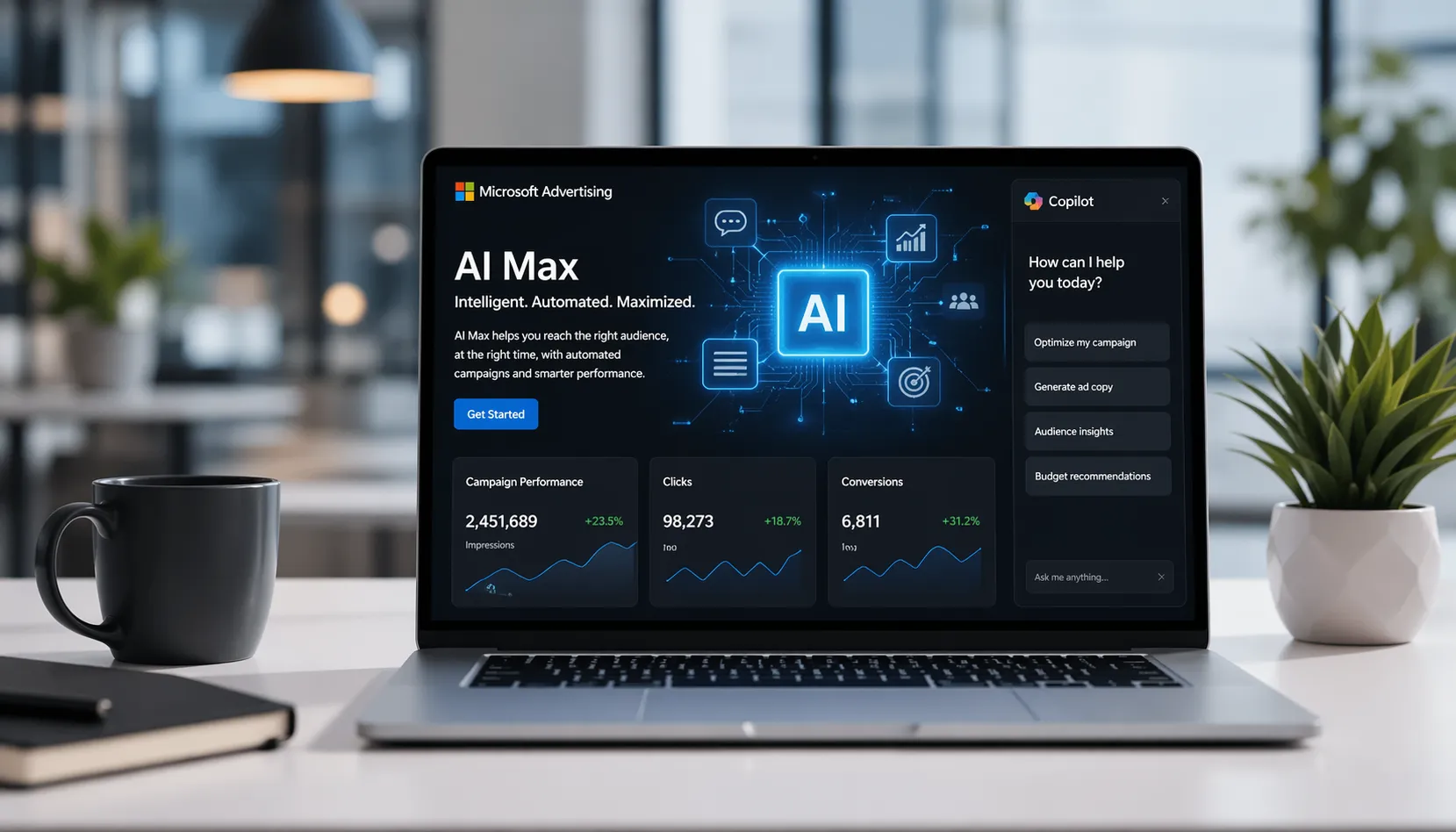
Microsoft AI Max is an advanced AI-powered advertising solution designed to meet the demands of the Agentic Web. Unlike traditional advertising platforms that require manual setup and continuous monitoring, AI Max leverages artificial intelligence to automate and optimize campaigns in real time.
Developed by Microsoft, AI Max serves as a powerful layer within the Microsoft Ads ecosystem, enabling businesses to create highly efficient and data-driven campaigns with minimal human intervention. It is designed to move beyond traditional pay-per-click (PPC) models by focusing on predictive analytics, intent-based targeting, and autonomous optimization.
One of the key features of AI Max is its ability to generate complete advertising campaigns automatically. From creating ad copy and visuals to selecting target audiences and allocating budgets, the system handles every aspect of campaign management. This significantly reduces the time and expertise required to run successful digital marketing campaigns.
Another important capability is predictive targeting. Instead of relying solely on historical data or keyword-based targeting, AI Max analyzes user behavior, preferences, and intent to identify potential customers more accurately. This ensures that ads are delivered to users who are most likely to convert.
Real-time optimization is another defining feature. AI Max continuously monitors campaign performance and makes adjustments instantly. Whether it is modifying bids, changing creatives, or refining audience segments, the system ensures optimal performance at all times.
Compared to traditional PPC tools, which require manual adjustments and periodic analysis, AI Max offers a fully automated solution that operates continuously. This shift from manual to autonomous campaign management represents a major advancement in digital advertising.
In simple terms, AI Max transforms advertising from a manual process into an intelligent, self-optimizing system.
4. Key Features of Microsoft’s New Ad Tools
Microsoft’s new advertising tools are designed to align with the demands of the Agentic Web, offering advanced capabilities that significantly improve efficiency and effectiveness.
a) AI-Powered Campaign Automation
One of the most important features is AI-driven campaign automation. The system can automatically create ad campaigns by generating headlines, descriptions, and visuals based on user data and market trends. It also identifies the most relevant audiences and sets up targeting parameters without requiring manual input. This reduces the complexity of campaign setup and allows businesses to launch campaigns quickly.
b) Conversational Ads
Another innovative feature is the introduction of conversational ads within AI interfaces such as Microsoft Copilot. Instead of traditional banner ads or search ads, users are presented with contextual recommendations during conversations with AI assistants. These ads feel more natural and less intrusive, as they are integrated into the user’s interaction with AI.
c) Intent-Based Targeting
Traditional advertising relies heavily on keywords, but Microsoft’s new tools focus on intent-based targeting. By analyzing user behavior, preferences, and context, the system can determine what users are likely to need and deliver relevant ads accordingly. This approach increases the chances of conversion and ensures that ads are shown at the right moment.
d) Real-Time Optimization
Real-time optimization is another critical feature. The system continuously monitors campaign performance and makes adjustments instantly. This includes modifying bids, updating creatives, and refining audience targeting. As a result, campaigns remain effective even as market conditions change.
Overall, these features can reduce manual marketing effort by up to 80 percent. Businesses can focus on strategy and creativity while AI handles execution and optimization.
The future of advertising lies in automation, personalization, and real-time intelligence.
5. How Advertising is Changing in the AI Era
The rise of AI technologies is fundamentally transforming the advertising landscape. Traditional methods that relied on keywords, manual campaign management, and click-based metrics are gradually becoming less effective. In their place, a new model is emerging that emphasizes intent, automation, and conversational interactions.
In the past, advertisers focused on selecting the right keywords to target users. Campaigns were manually created and optimized based on performance data. Success was measured primarily through clicks and conversions. However, in the AI era, these approaches are being replaced by more advanced techniques.
Intent-based targeting is becoming the new standard. Instead of focusing on what users search for, advertisers are now focusing on why they search. AI systems analyze user behavior and context to understand intent and deliver relevant ads accordingly.
Automation is another key change. AI-powered tools can manage entire campaigns without human intervention, from creation to optimization. This not only improves efficiency but also reduces the chances of human error.
Conversational ads are also gaining importance. As users interact more with AI assistants, advertising is becoming part of these conversations. This creates a more engaging and personalized experience compared to traditional ad formats.
As a result, the focus of digital marketing is shifting from generating clicks to influencing decisions. Businesses must adapt to this new reality by embracing AI-driven strategies.
The key question is no longer how to get clicks, but how to become part of AI-driven recommendations.
6. Impact on SEO and GEO
The emergence of AI-driven search and the Agentic Web has a profound impact on SEO and introduces a new concept known as Generative Engine Optimization (GEO). While traditional SEO focuses on optimizing content for search engine rankings, GEO focuses on optimizing content for AI-generated responses.
Platforms like Google are already implementing AI-driven search features such as the Search Generative Experience (SGE), which provides users with direct answers instead of a list of links. This significantly changes how users interact with search engines and how businesses attract traffic.
One of the biggest impacts is the reduction in organic traffic. As AI systems provide answers directly, users are less likely to click on individual websites. This leads to lower click-through rates and increased competition for visibility within AI-generated content.
To succeed in this new environment, businesses must adapt their SEO strategies. Content must be clear, structured, and optimized for AI understanding. This includes using concise language, answering user queries directly, and incorporating structured data.
Another important aspect is conversational optimization. As users interact with AI through natural language, content must be designed to match conversational queries. This requires a shift from keyword-focused writing to intent-focused content creation.
The key takeaway is that if content is not optimized for AI systems, it may not be visible at all in the future web.
As the best digital marketing company in Noida, Digital 360 helps businesses integrate SEO and GEO strategies to maintain visibility and relevance in this evolving landscape.
7. What This Means for Businesses
The introduction of AI Max and the evolution of the Agentic Web are not just technological advancements—they are strategic turning points for businesses across all industries. Whether small, medium, or large, every business must rethink how it approaches digital marketing, customer acquisition, and growth.
For Small Businesses
AI-driven tools like AI Max significantly lower the barrier to entry in digital marketing. Earlier, running effective ad campaigns required expertise in keyword research, bid management, and campaign optimization. Now, AI can handle most of these tasks automatically. This allows small businesses to compete with larger players by leveraging intelligent automation without needing large marketing teams or budgets.
For Enterprises
Large organizations benefit from scalability and efficiency. AI Max enables enterprises to manage multiple campaigns across different markets with minimal manual effort. Predictive targeting and real-time optimization ensure that campaigns remain effective even at scale. This results in better return on investment (ROI) and improved operational efficiency.
For Startups
Startups can leverage AI to accelerate growth. With faster campaign deployment and smarter targeting, they can quickly test ideas, reach the right audience, and scale successful strategies. AI reduces the time required to achieve product-market fit and helps startups compete in crowded markets.
Key Insight
In the AI-driven era, the biggest competitive advantage is not budget—it is speed of adoption. Businesses that embrace AI early will gain access to better data, faster insights, and more efficient marketing processes.
The future belongs to businesses that adapt quickly and integrate AI into their core marketing strategy.
8. Challenges and Risks of AI Advertising
While AI advertising offers numerous advantages, it is not without its challenges and risks. Businesses must approach this transformation with a balanced perspective to ensure sustainable success.
Over-Automation
One of the primary risks is over-reliance on automation. While AI can handle many tasks efficiently, excessive dependence may lead to a lack of control over campaigns. Businesses must ensure that human oversight remains part of the process.
Loss of Human Creativity
AI-generated content and ads can sometimes lack originality and emotional depth. Creativity is a key factor in successful marketing, and relying solely on AI may result in generic messaging that fails to resonate with audiences.
Data Privacy Concerns
AI systems rely heavily on user data to function effectively. This raises concerns about data privacy and compliance with regulations. Businesses must ensure that they follow ethical practices and protect user information.
Platform Dependency
Another challenge is dependence on AI platforms controlled by large tech companies like Microsoft. Over-reliance on a single ecosystem can limit flexibility and increase vulnerability to policy changes.
Balanced Approach
The most effective strategy is to combine AI capabilities with human expertise. AI can handle data analysis and automation, while humans bring creativity, strategy, and emotional intelligence.
The goal should not be to replace humans with AI, but to enhance human capabilities using AI.
9. How Digital 360 Helps Businesses Adapt
In this rapidly evolving digital landscape, businesses need expert guidance to stay competitive. As the best digital marketing company in Noida, Digital 360 plays a crucial role in helping brands transition into the AI-driven marketing era.
AI + SEO + GEO Integration
Digital 360 combines traditional SEO with advanced Generative Engine Optimization (GEO) strategies to ensure that content is optimized not just for search engines but also for AI-driven platforms. This ensures maximum visibility in both traditional and AI-powered search environments.
AI-Driven Advertising Strategies
With the rise of tools like AI Max, Digital 360 helps businesses design and manage AI-powered ad campaigns that deliver better performance with lower manual effort. From campaign setup to real-time optimization, every aspect is handled using data-driven insights.
Content Optimization for AI
Content is the backbone of digital marketing, and Digital 360 ensures that it is optimized for:
- AI engines
- Voice search
- Conversational queries
This increases the chances of being featured in AI-generated responses and recommendations.
Comprehensive Services
Digital 360 offers a wide range of services, including:
- Advanced SEO strategies
- Performance marketing
- AI content strategy
- Voice search optimization
- Conversion-focused campaigns
With a future-ready approach, Digital 360 ensures that businesses are not just prepared for change—they lead it.
10. Future of Digital Marketing in the Agentic Web Era
The future of digital marketing is being reshaped by the rapid adoption of AI technologies and the emergence of the Agentic Web. As AI systems become more advanced, their role in decision-making will continue to grow, fundamentally changing how marketing works.
AI Agents Replacing Traditional Browsing
Users will increasingly rely on AI agents to perform tasks such as searching, shopping, and decision-making. This reduces the importance of traditional websites and increases the importance of being part of AI recommendations.
Rise of Zero-Click Marketing
Zero-click interactions will become the norm, where users get answers without visiting websites. Businesses must focus on creating content that can be directly used by AI systems.
Personalized AI Ads
Advertising will become highly personalized, with AI delivering ads based on individual preferences, behavior, and context. This will improve user experience and increase conversion rates.
Voice and Conversational Commerce
With the growth of voice assistants and conversational interfaces, users will interact with brands through natural language. This requires businesses to optimize their content for voice search and conversational queries.
The Big Shift
Marketing will move from visibility to influence.
Instead of focusing solely on ranking and traffic, businesses will need to build authority and trust so that AI systems recommend them.
11. Conclusion
The launch of AI Max and new advertising tools by Microsoft marks a significant milestone in the evolution of digital marketing. It signals the transition from a search-driven internet to an AI-driven, action-oriented ecosystem known as the Agentic Web.
This transformation is not just about technology—it is about redefining how businesses connect with their audiences. Traditional strategies based on clicks, keywords, and manual optimization are gradually being replaced by AI-driven systems that focus on intent, automation, and real-time decision-making.
For businesses, the message is clear: adaptation is no longer optional. Companies must invest in AI-driven marketing strategies, optimize their content for AI platforms, and embrace new approaches such as GEO to remain competitive.
As the best digital marketing company in Noida, Digital 360 is committed to helping businesses navigate this transformation. By combining expertise in AI, SEO, and performance marketing, Digital 360 ensures that brands stay ahead in the ever-changing digital landscape.