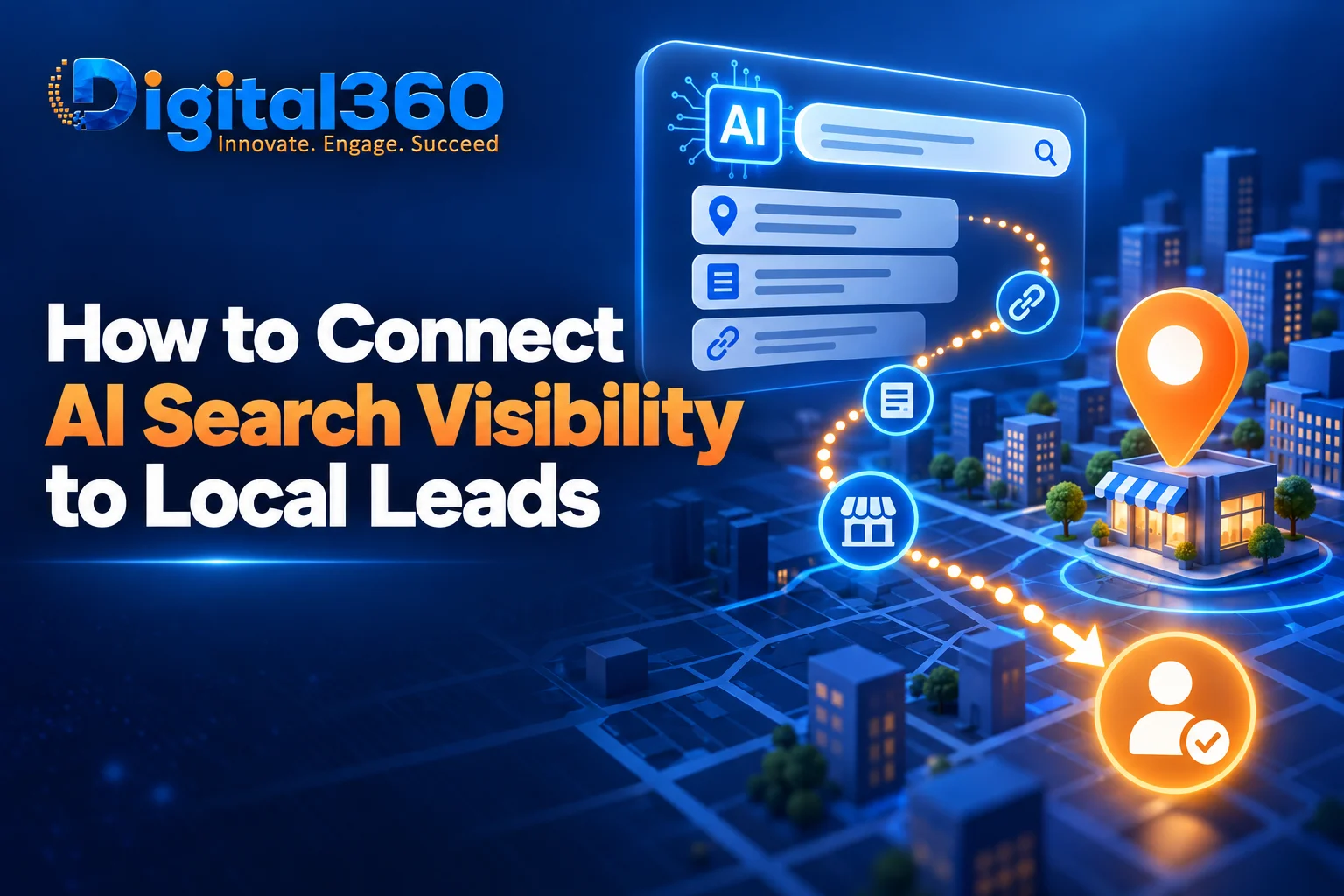
How to Connect AI Search Visibility to Local Leads
AI-powered search is changing how customers discover nearby businesses. Instead of entering a short keyword and opening several webpages, a person may ask a detailed question such as, “Which digital marketing agency near me helps small businesses generate leads?” An AI search tool can compare options, summarise services and recommend suitable providers in one response.
This creates an opportunity for local marketers, but visibility alone does not deliver business growth. A mention becomes valuable only when it contributes to a phone call, enquiry, appointment, store visit or sale. The main challenge is to understand how AI discovery influences the customer journey and then create a reliable route from recommendation to conversion.
This guide explains how to connect AI Search Visibility To Local Leads using accurate local information, citations, call attribution, prompt monitoring, reviews and real customer conversation data.
What Is AI Search Visibility?
AI search visibility refers to how frequently and accurately a business appears in AI-generated answers. Those answers may include local recommendations, service comparisons, contact details, directions, business summaries or links to supporting sources.
Traditional local SEO usually measures rankings, map visibility, impressions, traffic and clicks. AI discovery adds another layer because a business can influence a decision without receiving an immediate website visit.
For example, a customer may ask for a local service provider and see a business mentioned in the response. The customer might later search for that company by name, read its reviews and call from its business profile. Analytics may record the conversion as branded organic traffic or a profile interaction even though AI initiated the journey.
This is why marketers should not evaluate AI visibility only through referral sessions. Direct citation clicks matter, but assisted discovery, branded searches and customer-reported sources are also important.
Why AI-Assisted Local Leads Are Difficult to Track
The journey from discovery to conversion is rarely linear. A person may discover a business through one channel, verify it through another and make contact through a third.
A common path may include:
- The customer asks an AI tool for a nearby service recommendation.
- The tool mentions several businesses.
- The customer searches one business by name.
- They review its services, location and customer feedback.
- They call, send a message or submit a form.
The last interaction may receive all the credit even though AI shaped the original decision. Marketers therefore need a blended attribution approach rather than expecting one platform to reveal the complete journey.
1. Make Local Business Information Clear and Consistent
AI systems compare information from websites, business profiles, directories, reviews and other public sources. Conflicting details can reduce confidence and may result in outdated or inaccurate answers.
Audit the following information for every location:
- Official business name
- Complete address
- Local phone number
- Opening hours
- Main service categories
- Areas served
- Booking or enquiry options
- Location-specific services
- Parking or accessibility details, where relevant
Do not create unnecessary versions of the business name or publish different phone numbers without a tracking plan. Consistent information helps search systems connect multiple sources to one business and reassures customers that they have found the correct provider.
For multi-location brands, each branch should have its own useful page. Include the real address, service area, local contact information, operating hours and services available at that branch.
2. Create Pages for Real Local Questions
A generic service page may not answer the detailed questions people ask conversational search tools. Local pages should clearly explain what the business offers, where it operates and who it helps.
A useful local service page should include:
- A direct explanation of the service
- The city, locality or coverage area
- Common customer problems
- The process followed by the business
- Relevant experience and expertise
- Expected response or completion times
- Frequently asked questions
- A simple call to action
Avoid publishing many thin pages that only replace one city name with another. Each page should contain genuine local value, such as neighbourhood coverage, branch facilities, service availability, local requirements or examples relevant to that market.
Clear headings, concise answers and descriptive page titles also help machines interpret the page. Write naturally for customers first, but organise the information so individual facts are easy to identify.
3. Make Business Claims Specific and Verifiable
Vague claims such as “best service” or “number one company” provide little evidence. AI search tools and customers both benefit from precise statements.
A business can explain:
- The year it began serving a region
- The locations where a service is available
- The qualifications or experience of its team
- The type of customers it commonly supports
- The exact conditions of an urgent or same-day service
- The steps used to maintain quality
Every claim should be accurate, current and supported by the website or another trustworthy public source. Relevant structured data can also help search systems identify locations, services, contact information and frequently asked questions. It does not guarantee a recommendation, but it makes important details easier to understand.
Experience, expertise, authoritativeness and trust should be visible throughout the site. Use named authors where appropriate, add expert reviews to technical content, demonstrate real experience and update outdated information.
4. Track Citations and AI Referral Visits
When an AI answer links to a website, the visit may appear as referral traffic. Create a dedicated analytics segment for AI referrals and review:
- Sessions and engaged visits
- Pages receiving referral traffic
- Calls and phone-number clicks
- Forms and appointment requests
- Returning users
- Assisted conversions
- Lead quality
Traffic volume may initially be small. Treat AI discovery as an emerging channel and evaluate whether visitors are relevant, engaged and likely to enquire.
Citation monitoring is also useful even when it does not produce a click. Record which pages and external sources are cited for important local questions. This can reveal what information is considered reliable and where the business needs clearer supporting evidence.
Do not depend on one citation source. Visibility patterns can change as search systems update their models and retrieval methods. Build a broad, credible local presence across owned pages, business profiles, relevant directories, industry sources and genuine customer feedback.
5. Use Call Attribution Carefully
Phone calls are often the highest-intent action for local businesses. Call tracking can help connect an enquiry with its marketing source, but its implementation must protect the consistency of public business information.
Keep a stable primary local number in important business listings. Use tracking numbers in controlled campaigns or through carefully configured number replacement on the website.
Some AI crawlers may not process scripts exactly as a normal browser does. If a phone number changes only after a script loads, the crawler may still read the original number. Server-side implementation may improve attribution, but it must be tested carefully. Search systems and users should not receive misleading or materially different business information.
Review call quality, not only call quantity. Label whether each call was a new lead, existing customer, irrelevant enquiry, sales call or missed opportunity. This connects marketing visibility with genuine commercial outcomes.
6. Ask Customers How They Found You
Technical analytics cannot capture every AI-influenced journey. Add a simple question to enquiry and sales processes: “How did you first hear about us?”
Use it in:
- Website forms
- Appointment forms
- Call-handling scripts
- Sales qualification calls
- Reception processes
- Post-service surveys
Offer clear options such as online search, AI recommendation, social media, advertisement, customer referral and previous experience. Add an optional text field so people can provide more details.
Self-reported attribution is not perfectly precise, but it highlights journeys that tracking codes miss. Compare it with referral traffic, call data, form sources and branded searches to identify repeatable patterns.
7. Build a Focused Prompt Library
A prompt library is a list of realistic questions potential customers may ask AI search tools. It allows marketers to monitor whether the business appears, how it is described and which sources support the response.
Organise prompts by intent:
Discovery
- Who provides this service near me?
- Which companies offer this service in my city?
Comparison
- How should I compare local providers?
- Which option is suitable for my particular requirement?
Problem-Solving
- Who can solve this problem in my area?
- Where can I get urgent help for this requirement?
Brand Verification
- What services does this company provide?
- Where is this business located?
Start with 25 to 50 high-value prompts rather than tracking hundreds of questions without a purpose. For every check, record the date, prompt, location context, business mention, cited source, factual accuracy and required action.
AI responses may change because of wording, location, conversation context and system updates. Treat prompt monitoring as a trend line, not as a fixed ranking report. Review patterns across several checks before making major decisions.
8. Turn Customer Conversations Into Content Insights
Calls, enquiry forms, sales notes and website chats contain the language customers actually use. These conversations reveal needs that keyword tools may overlook.
Look for recurring patterns:
- Words customers use to describe their problems
- Questions asked before booking
- Price, timing and location concerns
- Services customers misunderstand
- Reasons for choosing or rejecting a provider
- Trust factors mentioned during calls
- Objections that delay a decision
If customers repeatedly use a phrase that does not appear on the website, create or improve relevant content. Add the language naturally to service pages, FAQs and articles while keeping the answer accurate and useful.
Protect privacy during this process. Remove personal information, limit access to authorised staff and follow applicable rules for recording, storing and analysing conversations.
9. Build a Strong and Genuine Review Profile
Reviews help customers validate an AI recommendation. They also contain current information about service quality, staff behaviour, location and the customer experience.
Encourage real customers to share honest feedback on relevant platforms. Never create fake reviews, pressure customers to leave only positive ratings or use incentives that violate platform policies.
A healthy review programme should focus on:
- A steady flow of recent feedback
- Authentic service descriptions
- Location-specific experiences
- Professional replies to positive and negative reviews
- Consistent standards across branches
- Quick action on repeated complaints
Avoid inserting unnatural keywords into every response. A helpful and individual reply is more credible than a repeated marketing template.
Negative reviews should not automatically be viewed as harmful. A professional response that acknowledges the concern and explains the next step can demonstrate accountability. Recurring complaints should also be shared with the appropriate team because reputation problems cannot be solved through content alone.
10. Capture Leads Outside Business Hours
Customers can research local services at any time. If they discover a business after operating hours, they still need a clear next step.
Provide one or more of the following:
- A short enquiry form
- Online booking
- A callback request
- A messaging option
- An automated acknowledgement
- Clear opening hours
- Helpful FAQs
State when a human will respond. Automation should support the customer without pretending to provide advice or assistance that requires a qualified professional.
Fast follow-up is essential because AI answers may show several suitable providers. A missed call or delayed response can send the lead to another option.
Businesses should also examine missed-call patterns. If a large percentage of qualified enquiries arrive outside working hours, consider extending response coverage, offering scheduled callbacks or using a trained support system to collect basic requirements.
Create a Clear Conversion Path
AI visibility generates value only when potential customers can take action easily. Every important local page should guide the visitor toward a suitable next step.
The call to action should match the service. A customer looking for an urgent local repair may prefer a phone call, while someone comparing long-term professional services may want to schedule a consultation.
Keep forms short and request only the information required to begin the conversation. Long forms can create unnecessary friction, particularly for mobile users.
Important conversion elements include:
- A visible phone number
- A short enquiry form
- A clear service-area statement
- Accurate operating hours
- Response-time expectations
- Trust indicators
- Location information
- A direct call to action
Test these elements regularly. A page may attract AI referral traffic but still fail to produce leads if it loads slowly, looks outdated or makes contact difficult.
How to Measure AI Visibility Against Local Leads
To Connect AI Search Visibility To Local Leads, combine discovery, engagement and conversion signals in one report.
| Discovery Signal | Engagement Signal | Lead Signal | Business Outcome |
|---|---|---|---|
| Mention in relevant prompts | Citation visit | Call or form | Qualified opportunity |
| Correct local information | Branded website visit | Booking request | Confirmed appointment |
| Supporting page cited | Business-profile action | Message or callback | Sale or store visit |
| Positive review themes | Return visit | Reported AI discovery | Revenue contribution |
Review these signals monthly. Measure lead quality alongside volume by checking whether enquiries relate to the locations and services the business wants to grow.
A small number of qualified enquiries can be more valuable than a large volume of irrelevant traffic. The purpose of reporting is not to prove that every AI mention created a sale. It is to identify relationships between increased visibility, customer behaviour and business outcomes.
Establish Governance for Multiple Locations
Businesses with several locations need central control over essential information. Without clear ownership, unauthorised phone numbers, duplicate listings, incorrect hours and inconsistent service descriptions can appear online.
The central marketing team should manage:
- Business naming standards
- Local page templates
- Structured data
- Primary phone-number policies
- Tracking-number rules
- Access to business listings
- Review response guidelines
- Reporting definitions
- Content approval processes
Local teams can provide branch-specific information, customer questions, photographs, service updates and operational details. Assign responsibility for checking and updating every location.
This combination of central control and local input helps protect accuracy without making every branch page identical.
Common Mistakes to Avoid
Businesses trying to improve AI visibility should avoid the following mistakes:
- Treating AI referral traffic as the complete customer journey
- Tracking too many prompts without analysing the results
- Publishing exaggerated or unsupported claims
- Creating thin pages for multiple locations
- Using inconsistent phone numbers
- Ignoring calls and customer conversations
- Depending on one citation source
- Collecting reviews through manipulative practices
- Leaving after-hours customers without a next step
- Reporting brand mentions without measuring lead quality
Avoid chasing every short-term change in AI-generated answers. Build a strong information foundation that remains useful across different search and discovery systems.
Final Thoughts
AI search does not replace local SEO, content, reputation management or conversion tracking. It brings them together. Businesses are easier to recommend when their information is consistent, their expertise is clear, their claims are verifiable and their customer experiences support what they publish.
The path from an AI answer to a local lead will not always appear in one analytics report. Marketers must combine citations, referral visits, prompt trends, branded discovery, call attribution, customer-reported sources, reviews and conversation data.
Digital360 helps local and multi-location businesses align these elements into one measurable strategy. The goal is not merely to appear in more AI-generated answers. It is to Connect AI Search Visibility To Local Leads that match the business, create genuine opportunities and contribute to sustainable growth.
Digital360 – a digital marketing company in Noida helps local and multi-location businesses align these elements into one measurable strategy. The goal is not merely to appear in more AI-generated answers. It is to Connect AI Search Visibility To Local Leads that match the business, create genuine opportunities and contribute to sustainable growth.