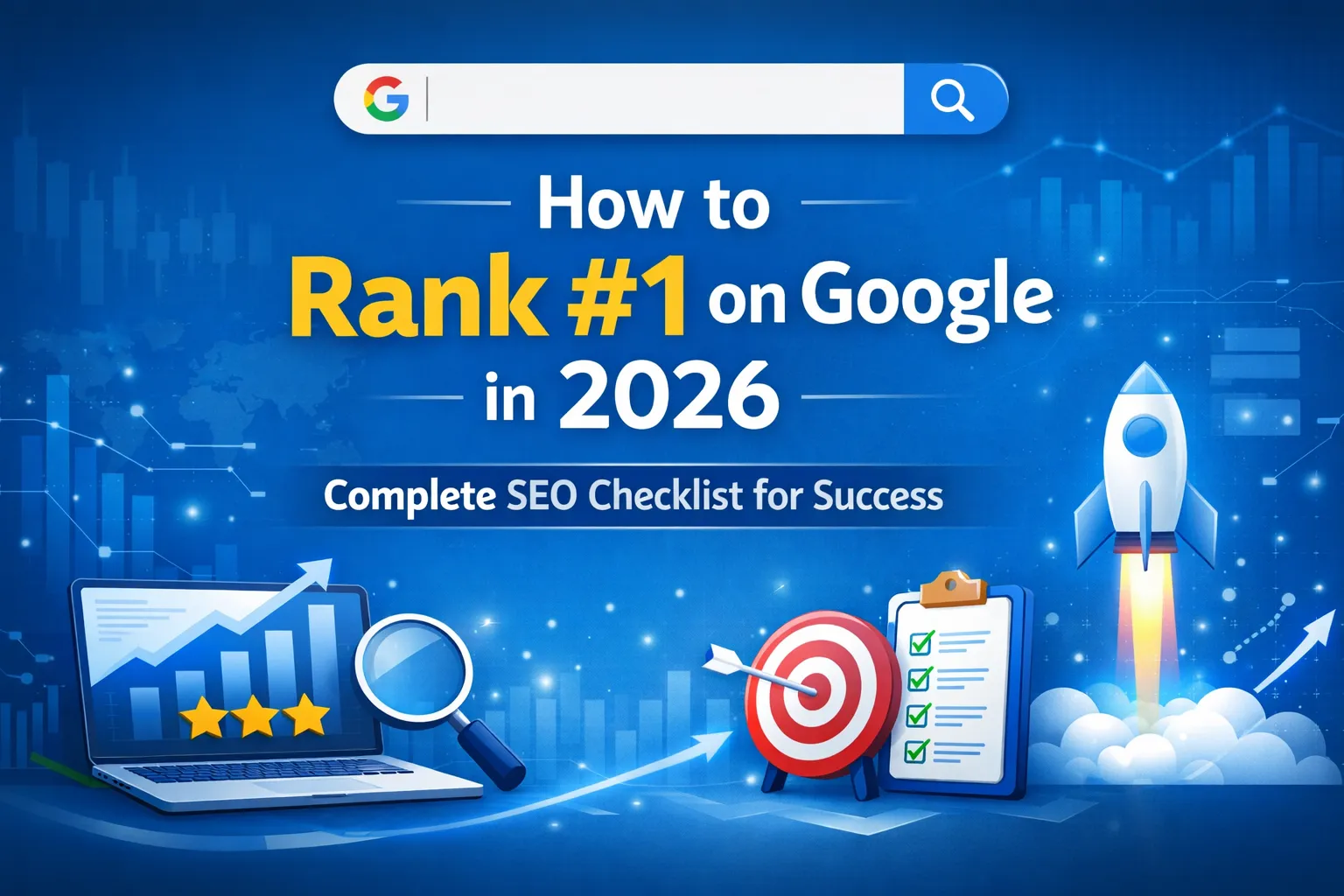
How to Rank #1 on Google in 2026: The Ultimate SEO + GEO Checklist
1. Introduction
Ranking on Google has never been easy—but in 2026, it’s a completely different game.
If you’re still relying only on traditional SEO tactics like keyword stuffing, backlinks, or basic blog writing, you’re already behind. Today, Google is no longer just a search engine—it’s an AI-powered answer engine. With the rise of AI-generated summaries, voice search, and zero-click results, users often get answers without even clicking a website.
This means the real challenge isn’t just to appear on Google—it’s to Rank #1 on Google in 2026 and dominate visibility across AI-powered results.
The biggest shift?
We’ve moved from SEO (Search Engine Optimization) to SEO + GEO (Generative Engine Optimization).
GEO focuses on making your content visible not only in traditional rankings but also inside:
- AI Overviews
- Featured snippets
- Voice search results
- Chat-based search interfaces
Here’s the reality:
“Ranking is no longer about keywords… it’s about authority, intent, and AI visibility.”
Google now prioritizes:
- Content that directly answers user intent
- Brands with proven expertise
- Websites that AI trusts enough to quote
So if your content isn’t structured for AI understanding, you’re missing a massive opportunity.
What This Guide Will Cover
In this ultimate checklist, we’ll break down exactly how to:
- Rank #1 on Google in 2026 using modern SEO + GEO strategies
- Understand how Google’s AI-driven ranking system works
- Find high-intent keywords that actually convert
- Build content that Google (and AI) prefers
- Create topical authority in your niche
- Optimize your website for both humans and machines
Whether you’re a business owner, marketer, or agency like Digital 360, this guide will give you a step-by-step blueprint to dominate search rankings in 2026 and beyond.
2. How Google Ranking Works in 2026
To Rank #1 on Google in 2026, you need to understand one thing clearly—Google doesn’t rank websites anymore, it ranks answers.
Evolution of Google Ranking
Earlier, Google focused on:
- Keywords
- Backlinks
- On-page SEO
But today, the algorithm is powered by AI and machine learning. Google analyzes:
- Context
- User intent
- Content quality
- Real-world expertise
This shift has completely changed how rankings work.
Key Elements of Modern SERPs
AI Overviews
Google now generates AI summaries at the top of results. If your content is strong, it can be featured inside these AI answers, giving you massive visibility—even without a click.
Featured Snippets
Quick answers shown in boxes. Structured content increases your chances here.
Zero-Click Searches
Users often get answers directly on Google, meaning your content must deliver instant value.
Google’s Core Focus: E-E-A-T
To Rank #1 on Google in 2026, your content must demonstrate:
- Experience – Real-world knowledge
- Expertise – Subject authority
- Authority – Recognition in your niche
- Trust – Accuracy and credibility
If your content lacks these, ranking becomes extremely difficult.
How Google Actually Works
1. Crawling
Google bots scan your website and discover pages.
2. Indexing
Your pages are stored in Google’s database.
3. Ranking (Modern Signals)
Today’s ranking signals include:
- Content relevance to intent
- User engagement (CTR, time on page)
- Website performance (Core Web Vitals)
- Mobile-first optimization
- Structured data
- Brand authority
Important:
Google now measures how helpful your content is, not just how optimized it is.
The Bottom Line
To Rank #1 on Google in 2026:
- Think like a user
- Write like an expert
- Structure like an AI
Because in today’s search landscape, visibility = trust + clarity + intent alignment.
3. Keyword Research in 2026 (Intent > Volume)
If you still choose keywords based only on search volume, you’re making a big mistake.
To Rank #1 on Google in 2026, keyword research is no longer about traffic—it’s about intent and relevance.
Types of Keywords You Must Target
Informational Keywords
Users want to learn.
Example: “how to rank #1 on Google in 2026”
Transactional Keywords
Users want to take action.
Example: “best SEO agency in Noida”
Navigational Keywords
Users are searching for a specific brand.
Example: “Digital 360 SEO services”
Long-Tail & Conversational Queries
With voice search and AI assistants growing, users now search like they speak:
- “How can I improve my website ranking fast?”
- “What is the best SEO strategy in 2026?”
These long-tail keywords are easier to rank and highly targeted.
Voice Search Optimization
To Rank #1 on Google in 2026, your content should:
- Answer questions clearly
- Use natural language
- Include FAQ sections
Tools You Should Use
- Google Search Console → Find real queries users search
- Ahrefs / SEMrush → Keyword difficulty and opportunities
- Google Autocomplete → Discover trending queries
Topic Clustering (Must-Have Strategy)
Instead of targeting one keyword, build clusters.
Example:
Main topic: Rank #1 on Google in 2026
Supporting topics:
- SEO checklist 2026
- AI SEO strategies
- Content optimization tips
This builds topical authority, which Google loves.
Search Intent Mapping
Before writing content, ask:
- What does the user really want?
- Information? Solution? Product?
If your content doesn’t match intent, it won’t rank—no matter how optimized it is.
Key Takeaway
To Rank #1 on Google in 2026:
- Focus on intent, not just keywords
- Use conversational queries
- Build topic clusters
- Align content with user needs
Because Google ranks relevance—not randomness.
4. Content Strategy That Ranks #1
Content is still king—but in 2026, only strategic content wins.
To truly Rank #1 on Google in 2026, you need a structured, data-driven content approach.
Pillar + Cluster Model
This is the foundation of modern SEO.
- Pillar Content → In-depth guide (like this one)
- Cluster Content → Supporting blogs linked to the pillar
This creates:
Better internal linking
Strong topical authority
Higher rankings
Build Topical Authority
Google prefers websites that dominate a niche.
Instead of writing random blogs, focus on:
- One niche
- Multiple related topics
- Deep coverage
Example:
If your niche is SEO:
- Keyword research
- Technical SEO
- Content strategy
- Link building
Why Long-Form Content Wins
To Rank #1 on Google in 2026, long-form content works because:
- Covers topics in depth
- Answers multiple queries
- Keeps users engaged longer
Ideal length: 1500–4000+ words
How to Structure Your Blog
Proper structure helps both users and AI.
Use Headings
- H1 → Main title
- H2 → Sections
- H3 → Sub-points
Add FAQs
Improves chances of ranking in snippets and voice search.
Use Tables & Lists
Makes content easy to scan.
Internal Linking
Connect related pages for better SEO.
Content Freshness Matters
Google loves updated content.
Update regularly:
- Statistics
- Examples
- Keywords
Even old blogs can rank again if refreshed.
Optimise for AI (GEO Strategy)
To Rank #1 on Google in 2026, your content must be AI-friendly:
- Clear answers
- Structured format
- Concise explanations
- Data-backed insights
Because AI pulls content that is:
✔ Easy to understand
✔ Factually correct
✔ Well-structured
5. GEO (Generative Engine Optimization) – The Future of SEO
If you want to Rank #1 on Google in 2026, traditional SEO alone is no longer enough. The future belongs to GEO (Generative Engine Optimization)—a strategy focused on optimizing content for AI-driven search experiences.
What is GEO?
GEO (Generative Engine Optimization) refers to optimizing your content so that AI tools like ChatGPT, Google SGE, and Gemini can understand, summarize, and present your content as direct answers.
Unlike traditional SEO (which focuses on rankings), GEO focuses on:
- Being selected by AI models
- Appearing in featured answers
- Becoming a trusted source of information
How AI Tools Show Results
Modern search is no longer just “10 blue links.” Platforms like:
- Google SGE (Search Generative Experience)
- AI chatbots like ChatGPT
- Google Gemini
…now provide instant summarized answers.
This means:
Users may not even click websites
AI chooses the best structured content
Only high-quality, clear answers get visibility
So, to Rank #1 on Google in 2026, your content must be AI-friendly.
How to Optimize for AI Answers (GEO Strategy)
Answer-First Writing
Start every section by directly answering the query.
Example:
“GEO is the process of optimizing content for AI-driven search engines.”
This increases your chances of being picked for snippets and AI summaries.
Clear Structured Answers
Use:
- Headings (H2, H3)
- Bullet points
- Short paragraphs
AI tools prefer clean, scannable content.
Entity-Based Content
Instead of only keywords, focus on entities:
- Brands
- Concepts
- Locations
- Tools
Example:
Instead of just “SEO tools,” mention:
Google Search Console, Ahrefs, SEMrush
This improves AI understanding.
FAQ-Rich Content
Include multiple FAQs with clear answers.
Why?
AI tools extract FAQ-style content easily
Helps in featured snippets + voice search
Semantic Writing
Don’t repeat keywords unnaturally. Use:
- Synonyms
- Contextual phrases
- Natural language
Example:
Instead of repeating “Rank #1 on Google in 2026,” also use:
- Google ranking strategies
- Top SEO practices
- Search visibility techniques
Snippet Optimization (Critical for GEO)
To dominate AI results:
- Write 40–60 word direct answers
- Use lists and tables
- Add definitions and summaries
Why GEO is the Future
In 2026:
- Search = AI-driven answers
- Rankings = trust + clarity
- Visibility = structured content
At Digital 360, GEO is not just a trend—it’s the core strategy to Rank #1 on Google in 2026.
6. On-Page SEO Checklist
If you want to consistently Rank #1 on Google in 2026, your on-page SEO must be flawless. Here’s a complete checklist used by Digital 360.
On-Page SEO Checklist for 2026
1. Title Tag Optimization
- Keep it under 60 characters
- Include your primary keyword: Rank #1 on Google in 2026
- Make it compelling
Example:
How to Rank #1 on Google in 2026 – Complete SEO Guide
2. Meta Description Optimization
- 150–160 characters
- Include keyword naturally
- Add CTA
Example:
Learn how to Rank #1 on Google in 2026 with proven SEO strategies, GEO techniques, and expert tips.
3. URL Structure
- Short and clean
- Include keywords
- Avoid numbers and unnecessary parameters
Example:
/rank-1-on-google-2026
4. Internal Linking
- Link to relevant pages within your website
- Use keyword-rich anchor text
- Improves crawlability and user experience
5. Keyword Placement
Strategically place your keyword:
- Title tag
- First 100 words
- Headings (H2, H3)
- Image alt text
- Conclusion
Avoid keyword stuffing—use natural placement.
6. Image Optimization (Alt Text)
- Add descriptive alt text
- Include keywords where relevant
- Compress images for faster loading
Example:
alt=”how to rank #1 on Google in 2026 infographic”
7. Schema Markup
Use structured data:
- FAQ schema
- Article schema
- Breadcrumb schema
This helps Google understand your content better and improves rich results.
8. Above-the-Fold Optimization (Important in 2026)
The first screen users see matters the most.
Include:
- Clear headline
- Primary keyword
- Value proposition
- CTA
Why?
Users decide within seconds whether to stay or leave.
9. Content Readability
- Short paragraphs
- Bullet points
- Simple language
Better readability = better engagement = higher rankings.
10. CTA Optimization
Guide users with clear CTAs:
- Contact us
- Book consultation
- Learn more
Final Insight
To Rank #1 on Google in 2026, on-page SEO is no longer optional—it’s a baseline requirement.
Digital 360 ensures every page is optimized for both users and AI algorithms.
7. Technical SEO That Impacts Rankings
Technical SEO is the backbone of your website. Without it, you cannot Rank #1 on Google in 2026, no matter how good your content is.
Core Web Vitals (Google Ranking Factor)
LCP (Largest Contentful Paint)
- Measures loading speed
- Should be under 2.5 seconds
CLS (Cumulative Layout Shift)
- Measures visual stability
- Avoid shifting elements
INP (Interaction to Next Paint)
- Measures responsiveness
- Ensure fast interaction time
Mobile-First Indexing
Google ranks your site based on its mobile version.
Ensure:
- Responsive design
- Fast mobile speed
- Easy navigation
Page Speed Optimization
- Use compressed images
- Enable caching
- Minimize CSS & JS
Fast websites rank higher and reduce bounce rate.
Crawlability & Indexing
Search engines must easily access your site.
Sitemap
- Submit XML sitemap to Google Search Console
- Helps search engines discover pages
Robots.txt
- Control which pages should be indexed
- Avoid blocking important pages
HTTPS Security
- Use SSL certificate
- Builds trust + ranking factor
Why Technical SEO Matters
Even the best content won’t rank if:
- Your site is slow
- Pages aren’t indexed
- Users leave quickly
To Rank #1 on Google in 2026, your website must be:
Fast
Secure
Crawlable
Digital 360 focuses heavily on technical performance + SEO compliance.
8. Off-Page SEO & Authority Building
To truly Rank #1 on Google in 2026, your website must build authority and trust beyond your own site.
Backlinks Still Matter (But Quality > Quantity)
Gone are the days of spammy links.
Focus on:
- High-authority websites
- Relevant niches
- Natural link building
One strong backlink > 100 low-quality links.
Brand Mentions
Even without links, brand mentions signal trust.
Example:
“Digital 360” mentioned in blogs, forums, or news
Google sees this as credibility.
Digital PR
PR is becoming a major SEO factor.
Get featured in:
- News websites
- Industry blogs
- Online publications
This builds authority + backlinks.
Guest Posting
Write for high-quality blogs in your niche.
Benefits:
- Backlinks
- Traffic
- Brand exposure
How to Build Authority in 2026
Thought Leadership
Publish:
- Research-based blogs
- Industry insights
- Case studies
Become a trusted voice in your industry.
LinkedIn Content Strategy
LinkedIn is powerful for SEO indirectly.
Post:
- Insights
- Trends
- Educational content
Build personal + brand authority.
Press Coverage
Get featured in media:
- Interviews
- Expert opinions
- News articles
Final Insight
In 2026:
SEO = Authority + Trust + Content
If Google trusts your brand, you will Rank #1 on Google in 2026 faster and more consistently.
Conclusion for Digital 360
To dominate search rankings:
- Combine GEO + SEO
- Optimize on-page + technical factors
- Build authority through off-page strategies
Digital 360 helps brands not just rank—but dominate Google in 2026.
9. E-E-A-T: The Real Ranking Factor
If you truly want to Rank #1 on Google in 2026, you need to understand one thing clearly—Google is no longer just ranking content; it is ranking credibility. This is where E-E-A-T (Experience, Expertise, Authority, and Trust) becomes the backbone of modern SEO.
Experience
Google now evaluates whether the content creator has first-hand experience. For example, product reviews written by someone who has actually used the product perform better than generic summaries. Adding real insights, screenshots, or practical use cases signals authenticity.
Expertise
Expertise refers to how well you understand the topic. In niches like finance, healthcare, or digital marketing, shallow content won’t help you Rank #1 on Google in 2026. You need in-depth, well-researched, and structured content that demonstrates knowledge.
Authority
Authority is built over time. When your website gets mentioned, cited, or linked by credible sources, Google starts recognizing your domain as a trusted entity. Publishing consistent, high-quality content in your niche strengthens this authority.
Trust
Trust is the most critical factor. Your website must feel safe, reliable, and transparent. Elements like HTTPS, clear policies, and genuine contact information all contribute to trustworthiness.
How to Improve E-E-A-T
- Author Profiles: Add detailed author bios with credentials, experience, and social links
- Real Data: Use statistics, original research, and updated insights
- Case Studies: Share real results, client success stories, or experiments
- Reviews & Testimonials: Build credibility with user-generated content
To truly Rank #1 on Google in 2026, your website must not just inform—it must prove credibility at every level.
10. Local SEO (If Business-Based)
If you run a business, local SEO is one of the fastest ways to Rank #1 on Google in 2026, especially for location-based searches like “digital marketing agency near me.”
Google Business Profile Optimization
Your Google Business Profile (GBP) is your digital storefront. Ensure all details—name, address, phone number (NAP), business hours, and services—are accurate and updated. Add high-quality images and regular posts to stay active.
Reviews Strategy
Reviews are a major ranking signal. Encourage satisfied customers to leave positive reviews and respond to them professionally. More importantly, consistency matters more than volume.
Local Keywords
Use geo-targeted keywords like “SEO agency in Noida” or “best digital marketing company in Delhi.” These keywords help Google understand your service area and match you with local searches.
Consistency Across Platforms
Make sure your business details are consistent across directories, websites, and social platforms. Even small inconsistencies can impact rankings.
Local SEO is not optional anymore. If done right, it can help your business dominate search results and Rank #1 on Google in 2026 for highly targeted queries.
11. SEO Analytics & Tracking
You cannot Rank #1 on Google in 2026 without tracking your performance. SEO is not guesswork—it’s data-driven.
Key KPIs to Track
- Organic Traffic: Measures how many users are coming from search engines
- CTR (Click-Through Rate): Indicates how compelling your title and meta description are
- Bounce Rate: Shows whether users are finding your content useful
- Keyword Rankings: Tracks your position for target keywords
Tools You Must Use
- Google Analytics: Helps you understand user behavior, traffic sources, and conversions
- Google Search Console: Provides insights into search performance, indexing, and keyword visibility
Why Tracking Matters
Data helps you identify what’s working and what’s not. If a blog is not performing, you can optimize it by improving content, adding internal links, or updating keywords.
The brands that consistently Rank #1 on Google in 2026 are those that constantly analyze, optimize, and improve their strategies based on real data—not assumptions.
12. Common SEO Mistakes to Avoid in 2026
Even the best strategies can fail if you make critical SEO mistakes. To Rank #1 on Google in 2026, you must avoid these common pitfalls:
Keyword Stuffing
Overusing keywords makes content unnatural and harms readability. Google now prioritizes natural language and user experience.
Thin Content
Short, low-value content will not rank. Google prefers in-depth, informative, and well-structured articles.
Ignoring Search Intent
If your content does not match what the user is searching for, it won’t rank—no matter how optimized it is.
No Internal Linking
Internal links help Google understand your website structure and improve user navigation. Ignoring them is a major mistake.
Slow Website Speed
A slow website increases bounce rate and negatively impacts rankings. Speed optimization is essential in 2026.
Avoiding these mistakes is just as important as implementing strategies. Sometimes, fixing errors is the fastest way to Rank #1 on Google in 2026.
13. Complete SEO Checklist (Printable Section)
If you’re serious about trying to Rank #1 on Google in 2026, this checklist will act as your execution blueprint.
Pre-Publishing Checklist
- Keyword research completed
- Primary keyword: Rank #1 on Google in 2026 placed strategically
- SEO-friendly title and meta description written
- Content matches search intent
- Headings (H1, H2, H3) properly structured
- Images optimized with alt text
- Internal and external links added
- Content is original, detailed, and valuable
Post-Publishing Checklist
- Page indexed in Google Search Console
- URL submitted for indexing
- Social media sharing done
- Initial backlinks created
- Performance monitored (traffic, CTR, ranking)
- Content updated if needed
Monthly SEO Checklist
- Update old content with fresh data
- Track keyword rankings
- Improve low-performing pages
- Build high-quality backlinks
- Fix technical issues (broken links, speed, mobile usability)
- Analyze competitors
This checklist is your action plan. Follow it consistently, and you’ll significantly increase your chances to Rank #1 on Google in 2026.