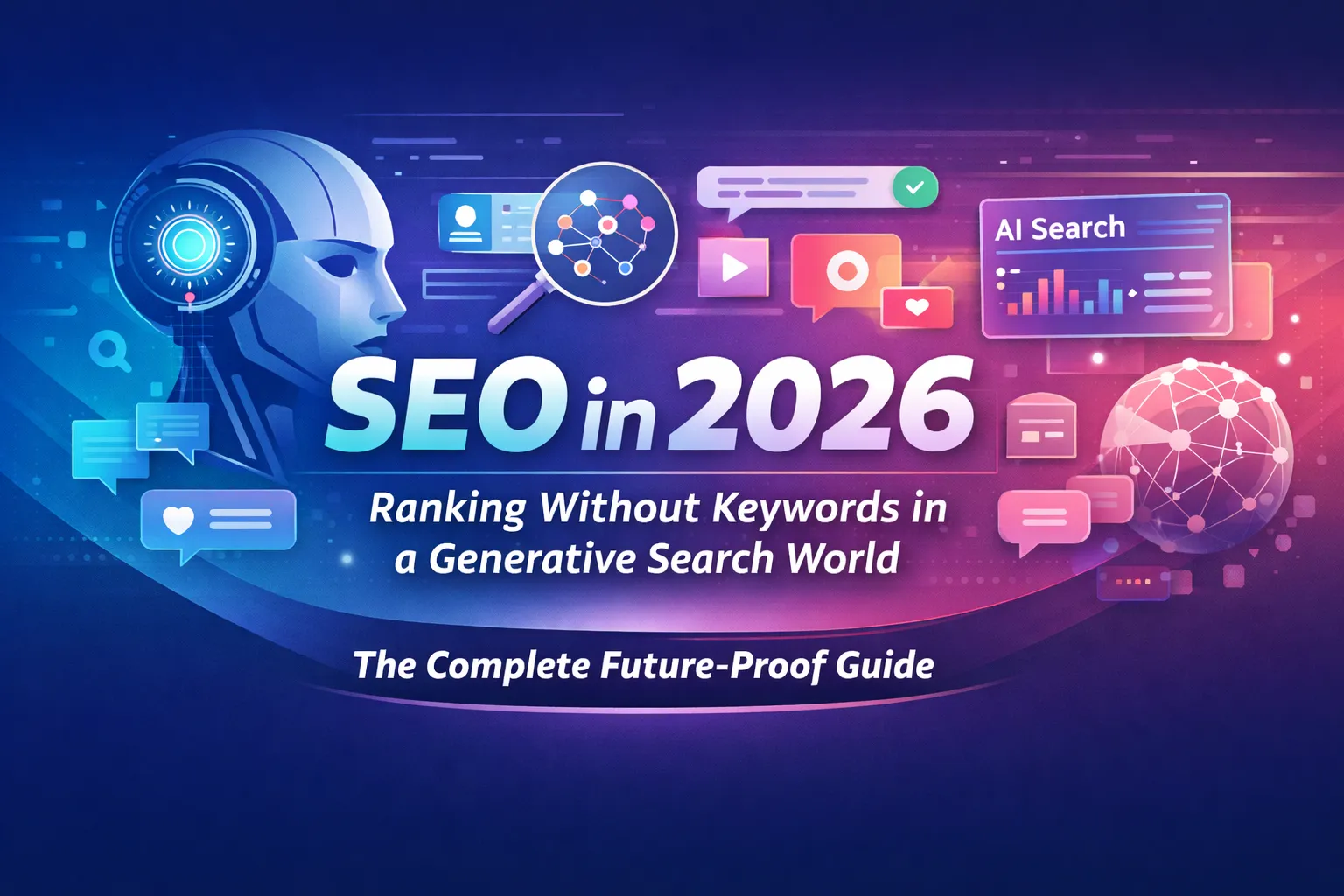
SEO in 2026: Ranking Without Keywords in a Generative Search World – The Complete Future-Proof Guide
Search is no longer a list of ten blue links.
By 2026, search has evolved into answers, recommendations, summaries, and decisions generated by AI—often without a single click. Brands are no longer just ranking pages; they are competing to be trusted sources inside AI-generated responses.
This shift marks the most important transformation in digital visibility since Google itself.
Welcome to SEO in 2026—where keywords don’t disappear, but authority, intent, and trust dominate everything.
This guide explains how brands rank without relying on keywords, how Generative Search Engines choose which businesses to recommend, and how Digital 360 builds SEO strategies designed not just for Google—but for AI-first search ecosystems.
Table of Contents
- The Death of Traditional Keyword SEO: Myth vs Reality
- How Generative Search Engines Actually Work
- From Keywords to Search Intent Graphs
- Topic Authority Beats Keyword Density
- From E-E-A-T to E-E-A-T-A-I: AI Trust Signals
- Answer-First Content Models
- Structured Data for AI Crawlers
- Brand Mentions vs Backlinks in 2026
- Visual, Video & Multimodal Search Rankings
- The Rise of Generative Engine Optimization (GEO)
- SEO vs GEO: Comparison Table
- Case Study: How Digital 360 Future-Proofs SEO
- SEO Roadmap for 2026–2030
- Common SEO Mistakes Businesses Will Make
- Industries Most Affected by Generative Search
- Future SEO Tools Stack for 2026
- AI-Optimized FAQs (15)
1. The Death of Traditional Keyword SEO (Myth vs Reality)
Myth: Keywords are dead.
Reality: Keywords have been absorbed into something much bigger.
In SEO in 2026, search engines no longer rely on exact-match phrases like “best SEO company in Noida.” Instead, they interpret:
- User intent
- Context
- Past behavior
- Entity relationships
- Trust signals
Keywords still exist—but they are no longer the ranking weapon.
What actually died?
- Keyword stuffing
- Exact-match anchor dependency
- Single-page keyword targeting
- Thin “SEO blogs” written only for bots
What replaced it?
- Intent clusters
- Entity-based understanding
- Answer reliability
- Brand authority
Traditional SEO didn’t vanish—it evolved into something deeper, smarter, and AI-driven.
2. How Generative Search Engines Actually Work
Generative search engines don’t “rank pages”—they assemble answers.
Platforms like Google SGE, ChatGPT, Bing Copilot, and Perplexity AI operate on similar principles:
Core mechanics
- Large Language Models (LLMs) interpret the query
- Vector search finds semantically related content
- Entity graphs connect brands, people, topics
- Trust scoring systems filter unreliable sources
- Answer synthesis generates the final response
Your website may never be clicked—but your brand may still win visibility.
That’s why SEO in the age of AI is no longer traffic-only—it’s presence inside AI answers.
3. From Keywords → Search Intent Graphs
In 2026, search queries are interpreted as intent networks, not phrases.
Example:
User query:
“Which SEO agency can help us dominate AI search in 2026?”
The AI breaks this into:
- Commercial intent
- Enterprise-level expectation
- Future-focused SEO need
- GEO expertise requirement
It then scans for:
- Brands frequently mentioned with SEO + AI + GEO
- Demonstrated expertise
- High-trust content
- Consistent authority across the web
This is called an intent graph.
Winning strategy
Instead of optimizing for:
“SEO in 2026 services”
You optimize for:
- SEO evolution
- AI search visibility
- GEO frameworks
- Long-term authority
This is why SEO without keywords works—because intent matters more than phrasing.
4. Topic Authority, Not Keyword Density
One of the biggest ranking factors in SEO in 2026 is topic authority.
What is topic authority?
It’s how deeply and consistently your brand covers a subject across:
- Blog pillars
- Supporting articles
- FAQs
- Case studies
- Thought leadership
AI asks:
“Who owns this topic on the internet?”
Digital 360 approach
Instead of 20 keyword blogs, we build:
- 1 pillar guide (like this)
- 5–10 supporting articles
- Industry-specific examples
- AI-friendly FAQs
This content ecosystem signals authority to generative engines.
5. From E-E-A-T to E-E-A-T-A-I (AI Trust Signals)
Google’s original framework:
- Experience
- Expertise
- Authoritativeness
- Trustworthiness
In 2026, a fifth layer exists:
E-E-A-T-A-I
A = AI Interpretability
AI evaluates:
- Is this content factual?
- Is it consistent across sources?
- Is the brand reputable offline and online?
- Does it avoid manipulation or hype?
Signals AI trusts:
- Author bios with real credentials
- Consistent brand mentions across platforms
- Long-form, structured explanations
- Clear ownership of opinions
This is where future of SEO becomes reputation engineering—not hacks.
6. Answer-First Content Models
Ranking pages is secondary.
Providing answers is primary.
AI-friendly content structure
- Clear headings
- Direct responses in first 100 words
- Bullet-point explanations
- Tables and comparisons
- FAQs with natural language
Why this works
Generative engines extract answer blocks, not entire articles.
If your content answers better, it gets cited more.
7. Structured Data for AI Crawlers
Schema markup is no longer optional.
In SEO in 2026, structured data helps AI:
- Identify entities
- Understand relationships
- Verify credibility
High-impact schemas
- Organization
- Article
- FAQ
- HowTo
- Author
Structured data acts like metadata for AI comprehension.
8. Brand Mentions vs Backlinks in 2026
Backlinks still matter—but brand mentions matter more.
AI evaluates:
- How often your brand is referenced
- Context of mentions
- Sentiment analysis
- Cross-platform consistency
Example
A brand mentioned on:
- Blogs
- Podcasts
- Industry articles
may outrank a site with more backlinks but less brand trust.
9. Visual, Video & Multimodal Search Ranking
Search is no longer text-only.
AI processes:
- Images
- Videos
- Audio
- Screenshots
Ranking signals
- Video transcripts
- Alt-text relevance
- Image authority
- YouTube AI search visibility
Brands using multimodal SEO dominate zero-click discovery.
10. The Rise of Generative Engine Optimization (GEO)
GEO = optimizing for AI answers, not just rankings.
GEO focuses on:
- Being cited by AI
- Owning entities
- Authority consistency
- Answer reliability
SEO drives traffic.
GEO drives recommendation.
In 2026, brands need both.
11. SEO vs GEO: Comparison Table
| Aspect | Traditional SEO | GEO (2026) |
|---|---|---|
| Focus | Rankings | AI recommendations |
| Keywords | Primary | Contextual |
| Traffic | Clicks | Visibility |
| Authority | Links | Entity trust |
| Content | Optimized | Answer-driven |
12. Case Study: How Digital 360 Future-Proofs SEO
Digital 360 doesn’t chase algorithms—we build authority systems.
Our framework:
- SEO + GEO hybrid strategy
- Pillar-led content architecture
- Entity mapping
- Brand trust amplification
- AI-ready structured content
Result:
Clients gain:
- Visibility across AI search
- Brand recall without clicks
- Sustainable rankings beyond Google updates
13. SEO Roadmap for 2026–2030
Phase 1 (2026)
- Entity optimization
- AI-friendly content
- Schema-first architecture
Phase 2 (2027–2028)
- Multimodal dominance
- Voice & assistant optimization
- GEO expansion
Phase 3 (2029–2030)
- Brand-first discovery
- AI partnership visibility
- Trust-driven market leadership
14. Common SEO Mistakes Businesses Will Make
- Chasing keywords
- Ignoring AI search
- Publishing thin content
- Over-optimizing anchors
- Skipping authority building
15. Industries Most Affected by Generative Search
- SaaS & Tech
- Finance & FinTech
- Healthcare
- Education
- E-commerce
- Professional services
These industries must adapt first—or disappear fastest.
16. Future SEO Tools Stack for 2026
- AI content analyzers
- Vector-based SEO tools
- Entity tracking platforms
- Brand mention monitoring
- Multimodal optimization tools
17. AI-Search Optimized FAQs (15)
1. What is SEO in 2026?
SEO in 2026 focuses on authority, intent, and AI trust rather than keyword rankings, helping brands appear inside generative search results.
2. Is SEO without keywords really possible?
Yes. Modern AI interprets intent, context, and entity relevance rather than exact keyword usage.
3. What is Generative Engine Optimization (GEO)?
GEO optimizes content to be cited and recommended by AI-powered search engines like Google SGE and ChatGPT.
4. How does AI decide which brand to recommend?
AI evaluates trust signals, authority, consistency, and answer quality across multiple sources.
5. Are backlinks still important in 2026?
Yes—but brand mentions and authority signals often outweigh raw backlink counts.
6. What content length works best for AI search?
Comprehensive, structured, long-form content with clear answers performs best.
7. How important is schema markup now?
Critical. Structured data helps AI understand and trust your content.
8. Does Google SGE replace traditional SEO?
No. It expands SEO into answer-first visibility.
9. How does Digital 360 approach SEO in 2026?
By combining SEO, GEO, entity optimization, and AI-ready content strategies.
10. Is traffic still important?
Traffic matters—but brand visibility inside AI answers matters more.
11. Can small brands compete in AI search?
Yes—through niche authority and consistent expertise.
12. How often should content be updated?
Continuously, to maintain relevance and trust.
13. Does video SEO matter for AI?
Absolutely. AI prioritizes multimodal content.
14. What is entity-based SEO?
Optimizing your brand as a recognized, trusted entity in AI knowledge graphs.
15. Is SEO dead after 2026?
No. It has evolved into a smarter, AI-driven discipline.
Final Thoughts: The Future Belongs to Authority
SEO in 2026 is no longer about gaming algorithms—it’s about earning trust at scale.
Brands that win will:
- Educate, not manipulate
- Answer, not stuff
- Build authority, not pages
At Digital 360, we don’t optimize for today—we engineer visibility for the next decade of search.
Best Digital Marketing Company in Noida & Leading GEO Company (Generative Engine Optimisation)
Digital marketing in 2026 is no longer just about rankings and traffic—it’s about visibility inside AI-driven search engines. As the best digital marketing company in Noida, Digital 360 helps brands stay ahead by combining traditional SEO with GEO (Generative Engine Optimization) strategies.
Our approach focuses on AI search visibility, brand authority, entity-based optimization, and answer-first content that gets featured across Google SGE, AI overviews, and generative search platforms. From SEO, content marketing, and performance campaigns to future-ready GEO frameworks, we design strategies that ensure your brand is recommended, trusted, and discovered, not just ranked.
If you’re looking for a GEO company in Noida that understands how AI search works and how brands win in it, Digital 360 delivers scalable, future-proof digital growth.